Our whole-school, preventative wellbeing approach is vital to our community feeling safe, valued, and respected at Elsternwick Primary School.
Key Points:
Our wellbeing curriculum incorporates the Respectful Relationships program, Zones of Regulation, Restorative Practices, and sexuality and consent education and aligns with the Department of Education’s Social and Personal Capabilities Curriculum.
Our commitment to diversity and inclusion is informed by our participation in a 2019 pilot program, ‘A human rights approach to diversity and inclusion for Victorian schools’, a partnership between the Department of Education and the Victorian Equal Opportunity and Human Rights Commission.
Elsternwick Primary School is a child-safe organisation that welcomes all children, young people and their families. We are committed to providing environments where our students are safe and feel safe, where their participation is valued, their views respected, and their voices are heard about decisions that affect their lives. Our child-safe policies, strategies and practices are inclusive of the needs of all children and students and are available on our Policy Page.
Supporting positive behaviour
We take a preventative approach to behaviour management by consistently applying supportive positive behaviour. Our guidelines complement the wellbeing curriculum framework to ensure we use a common language across the school and deal with incidents through a respectful, supportive and restorative process.
Zones of regulation
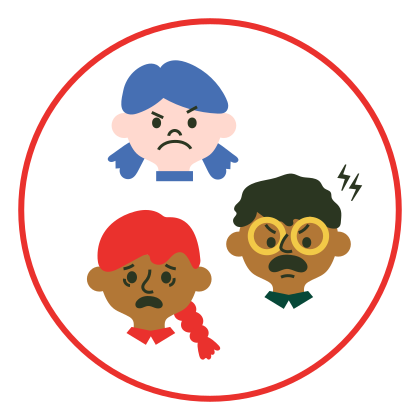
THE RED ZONE
The Red Zone describes extremely heightened states of alertness and intense emotions like anger, rage, explosive behaviour, devastation, or terror.
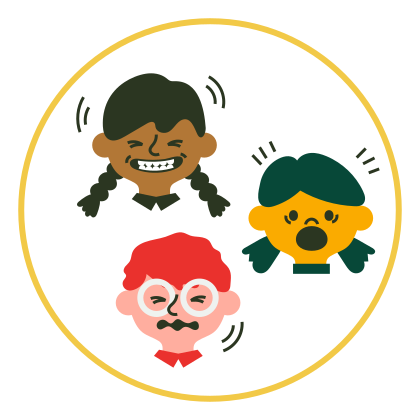
THE YELLOW ZONE
The Yellow Zone also describes a heightened state of alertness and elevated emotions; however, the student has some control when in the Yellow Zone. They may be experiencing stress, frustration, anxiety, excitement, silliness, wiggles, or nervousness when in the Yellow Zone.
THE GREEN ZONE
The Green Zone is used to describe a calm state of alertness. A student is happy, focused, content, or ready to learn in the Green Zone. Optimal learning occurs in this zone!
THE BLUE ZONE
The Blue Zone describes low states of alertness and down feelings, such as when the student feels sad, tired, sick, or bored.
Restorative practices
The term ‘Restorative Practices’ refers to how our classrooms promote genuine relationships, resulting in better behaviour and learning at school. It also refers to asking our students to think about and take responsibility for their behaviour and its effect on others. This approach endeavours to build a caring community around students whilst not accepting harmful behaviour. When conflicts occur, the restorative approach involves all those affected to find a way forward.
Student support
On-site Psychology, Speech Therapy and OT services
We’ve partnered with external operators to organise an on-site psychologist service, on-site speech therapy and OT services. These operate from our Green Zone. We’ve had much feedback from families that sourcing private allied health professionals can present many challenges, including long waitlists, travel logistics and limited availability outside of school hours.
Accessing this service allows us to have a more collaborative approach to student’s wellbeing, with communication between parents/carers, classroom teachers and private therapists on shared goals. Should you wish to access these services, please contact the office or the Assistant Principal, and we’ll advise you of the intake process.
The Green Zone
Established at EPS in 2018 and refurbished in 2023, our ‘Green Zone’ is a unique, multipurpose space supporting the wellbeing of students at our school.
It is used for explicit teaching of wellbeing curriculum and also operates during recess and lunch to support students who need additional support with the social and emotional aspects of break times.
The Green Zone environment encourages calm and focus, supports relationships, and aligns with our Zones of Regulation social thinking approach.
Our Inclusion Coordinator
Our inclusion coordinator works with students across the school to support them in developing their social, emotional and communication skills. Our inclusion coordinator manages our ‘Green Zone’ and provides targeted support and intervention with small groups of students during learning time.
Students may work together on problem-solving, turn-taking, building peer relationships, sharing, listening, compromising, teamwork, managing anxiety, mindfulness strategies and more.
Student leadership and agency
Student voice
Students actively participate in developing their learning environments and class communities. Voice and agency are supported with weekly Student Voice Meetings to maximise students’ engagement and participation in all areas of school life (see leadership and student voice and agency for more details).
Year 4 — Buddies
Prep students are assigned a Year 4 buddy at the start of the year. Buddies meet once a week, and students also meet with their buddies for 300K. The Buddy program supports Prep students with their transition to school. It begins to develop the leadership capacity of our Year 4 students.
Year 5 — Peer mediators
Year 5 students do a fantastic job demonstrating empathy and facilitating minor conflict resolution in the yard using a five-step process based on our restorative practices approach. Peer mediation is where two or more students involved in a dispute meet in a private, safe and confidential setting with the assistance of a trained student mediator. Our Year 5 students complete training with two staff members accredited in Peer Mediation and work alongside yard duty teachers in the yard and wear high-vis vests.
Year 6 — Leadership
Year 6 students have many formal and informal opportunities to demonstrate their leadership skills throughout the year. All students receive a leadership badge after participating in a leadership conference in term 1.
Formal roles include School Captains and Vice Captains, House Captains and Vice Captains, Arts Leaders, Wellbeing Leaders and Student Representative Council members. These positions are all elected through a selection process.
Other opportunities are open to all students, including hosting assemblies, assisting with the Prep Transition Program, helping with sports days, assisting with school tours, hosting the Celebrate the Sixes carnival and coordinating the 300K laps system.
Student Representative Council (SRC)
The Student Representative Council (SRC) comprises one elected student per class from Years 3-6. SRCs attend fortnightly meetings and fundraise, promote advocacy, sustainability, social and cultural wellbeing, and empower our students to take action within our community.
Our favourite wellbeing resources for parents and carers
Evidence-based tools and resources to assist and support young people and their parents/carers, especially those with developmental challenges and disabilities.
In addition to free 24/7 online and phone counselling for young people, Kids Helpline also offers age-appropriate resources and parent/carer resources on mental health, physical health and identity, friendship issues and more.
Parentline
Phone: 13 22 89 Parentline is a phone service for parents and carers of children from birth to 18 years old. We offer confidential and anonymous counselling and support on parenting issues.